Jawbone Headset Campaign

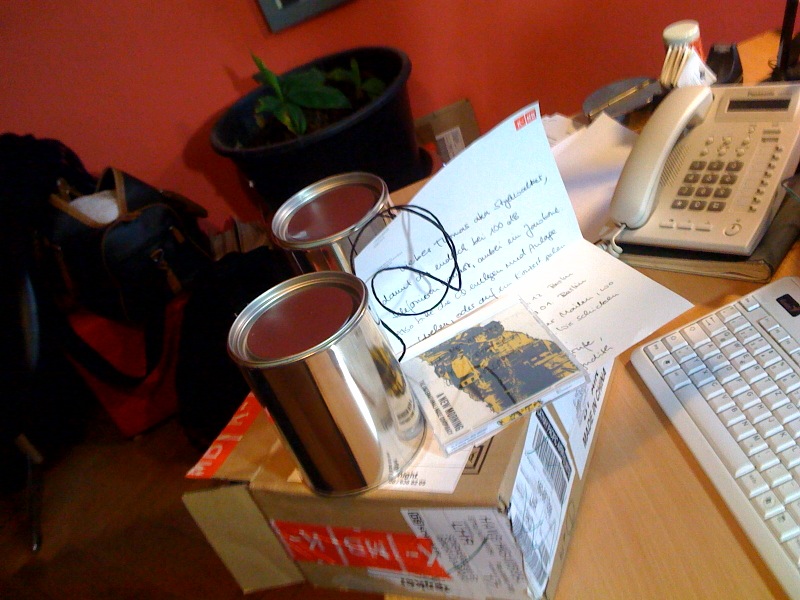
jawbone_german_campaign_01Last week, I got a package via mail which looked quite interesting, sent to me by K-MB, a brand consultancy from Berlin.

Opening it, I found two cans connected by a thread just like one of those tin can telephones kids connect their rooms over the street with. Also, a Noise Conspiracy cd and a nice handwritten letter, inviting me to either a Babyshambles or a Noise Conspiracy concert.

Since Babyshambles are cancelled (what a surprise..) I guess, I’ll go for Noise Conspiracy on January 19th.

jawbone_german_campaign_01Opening the cans, I found one of them filled with earplugs and other stuff which turned out to be a bluetooth headset, namely a Jawbone.

I am not only impressed by the effort of this campaign; which also got coverage on other blogs like Lumma.de or blog.telefon.de but also by the product.

It looks nice, the descriptions are comprehensive. It connected easily and fast with the iphone, I just managed the first phonecall with it and the speech quality is good and everything works well. Besides, it comes with a charging unit and several eargear in different sizes.

Good product, good idea.

Create a job and service profile, connect with others, make offers and earn money.

Ford Fiesta commercial 2008 song

Many ask: “What’s this track in the ford fiesta commercial with the pink car in front of many moving tv screens” or “Wie heißt der Song aus der Ford Werbung”? It’s “Transient” by Pluxus, Swedes who live partly in Berlin and come out on the label Pluxemburg. The song is very groovy, deep, longing, and a little glossy, perfect match for the commercial. Props to Ogilvy London to buy it!

Facebook for teaching and learning

I wrote the following article together with Max Senges and Peter Bihr for the UOC Fórum Innovació.

Social Communities have grown rapidly over the last years, offering people the chance to publish personal information and connect with each other. The biggest social community today is Facebook with more than 120 million members. Due to the myriad possibilities to use Facebook, there many ways to support teaching and learning.

Facebook started in 2004 at Harvard University and was aimed at connecting students. Now, almost every American student and many Europeans have profiles on Facebook. They use it to share information, such as links, photos and videos, to arrange real life events and to communicate in groups.

digital native learners and digital immigrant teachersFrom: http://www.apple.com/au/education/digitalkids/disconnect/landscape.htmlFace

The use of Facebook also shows the current cultural differences between teachers who slowly have to adapt to new technologies and students who grew up with digital communication. The differences in media use and learning behaviour between so called “digital native learners” and “digital immigrant teachers” are shown below. Understanding how to use Facebook opens up a way to stepping closer to actual student behaviour and to create a more appropriate way of teaching.

Read on at the UOC Fórum Innovació.

Facebook for Services, students create job and service profiles

P3000 Blogpost Widget from Sproutbuilder

Greenhouse.sproutbuilder.com is an absolute blast. It’s a flash based widget builder which works entirely in your browser window and has a lot of editing features. Build sites with text, video, pictures, slideshows, maps, charts or insert RSS. Define size, fonts, colors, background, effects. Here are the most recent updates from the PANORAMA3000 blog in a widget, it took me 20 minutes to make it nice.

Jump on Kanye’s Love Bus

Auf myspace.com/urbanstreetteam gibt es eine nette Competition: Freund werden, Foto in das eigene MySpace-Profil hochladen, mit dem Urban Streetteam Profil verlinken und dann Kommentare auf dem Foto sammeln. Dazu kriegt jeder noch ein stylishes Widget zum eigenes-Bild-promoten.

Das Foto mit den meisten Kommentaren gewinnt – ein Trip im Bus inkl 5 weitere Freunde zum Konzert nach Oberhausen.

Spread the love!

How to build a halfpipe

Very well made video by the German ministry of labour to promote their “Ausbildungsbonus“, a public promotion for companies that are willing to train apprentices who otherwise would have a hard time to find a workplace.

Note: Sadly enough, the information what the Ausbildungsbonus really is, is rather hidden within the page: It is a one-time payment of 4000 to 6000 EUR (depending on the wage) which is paid to companies 50% when the training starts and 50% when the apprentice applies for the final exam.

Gesellschaftliche Gründe für die Flucht in virtuelle Welten

Gestern hatte ich die Ehre, auf dem Virtual Worlds Camp einen Vortrag über “Gesellschaftliche Gründe für die Flucht in virtuelle Welten” zu halten. Nach einigen Anfangsschwierigkeiten stürzte ich mich voll in die Soziologie der Regeln und Sanktionen, der sozialen Anerkennung und Identifikation und hatte am Ende eine zwar nicht perfekte, aber immerhin so anregende Präsentation beisammen, dass sich eine äußerst lebhafte Diskussion entwickeln konnte. Danke an alle Teilnehmer, hier finden sich die Folien via Slideshare.

Tomorrow: Virtual Worlds Camp @Frogster IP

Tomorrow I’ll be talking about virtual worlds and social reasons for escaping into them at the Virtual worlds camp. The camp will take place at Frogster IP, in Hardenbergstraße 9a, Berlin, from 11.00h to 16:00h. I’m talking at 14:15, you can watch the whole conference on Hobnox.

Beside me, there will be other experts, like Computec Media AG CEO Johannes Sevket Gözalan, Sunny Park from Frogster Korea or Mirko Caspar from Metaversum, talking about virtual worlds, gaming in general, promotion and business models within that area.

There will be a party at night, too, where I’ll be djing at a secret place you will have to find out by asking the sausage seller at Choriner Str, corner to Schönhauser Alle. You can register for the event at amiando.

Wordle – Beautiful word clouds

obama_mccain_acceptancespeec_wordle“Wordle is a toy for generating “word clouds” from text that you provide. The clouds give greater prominence to words that appear more frequently in the source text. You can tweak your clouds with different fonts, layouts, and color schemes. The images you create with Wordle are yours to use however you like..”

I discovered Wordle in a Twitter-tweet by Steve Rubel where he compared Obama’s and McCain’s acceptance speeches with the help of this text analysis tool. It’s very open to interpretation indeed but somehow pretty and illustrative.

I compared two speeches of Müntefering and Merkel, the one Müntefering held at the Parteitag in Hamburg and one Merkel held to celebrate the Soziale Marktwirtschaft. They were surprisingly similar. A very interesting fact is that both use the word “müssen” a lot. Maybe German politicians should think about putting their messages into sentences with more “können”.

You can see Müntefering’s speech on the left side (obviously, Merkel wouldn’t say “Genossen”) and Merkel’s on the right side.